

Protestantism is an expression of Christian faith that was shaped by the Reformation movement of the 16th century, aiming to return to the essential message of the Gospel. This movement sought to re-examine teachings and practices within the church in the light of the Holy Scriptures and to live in accordance with the message of the Bible.
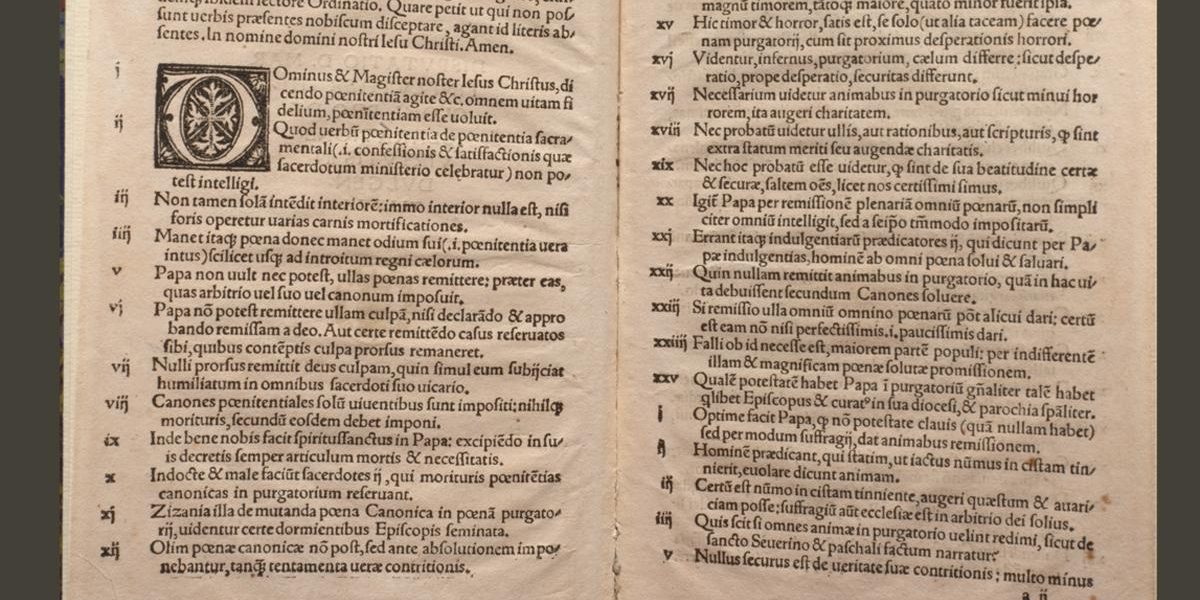
The roots of Reformation thought reach back to earlier centuries. Theologians such as John Wycliffe (1330–1384) and John Huss (1369–1415) drew attention to certain practices within the church that they believed were inconsistent with the Scriptures and emphasized the need to restore the central role of the Bible. However, a defining moment of the Reformation occurred in 1517, when Martin Luther posted his Ninety-Five Theses on the door of the church in Wittenberg. This event is widely recognized as the beginning of the Protestant Reformation.
The term “Protestant” was originally used to describe believers who objected to certain decisions and practices of that time. Over time, the term came to be associated with the broader reform movement that emphasized faithfulness to the Scriptures.
The first pages of the 1517 Basel edition of Luther’s 95 Theses
Core Understanding of Protestantism
Although Protestantism has developed a rich and comprehensive theological heritage, its core understanding may be summarized under the following headings:
📖 Authority of the Holy Scriptures
Protestants believe that the Holy Bible (Old and New Testaments: the Law, the Psalms, the Writings of the Prophets, and the Gospel) is the Word of God and the only reliable and authoritative source for faith and life.
The Scriptures stand at the center of faith and worship, and all teachings are evaluated in the light of the Bible.
⛪ Understanding of Church and Worship
According to Protestant understanding, the church is first and foremost not a building, but a community of people who believe in God. The word “ekklesia” (church), used in the Scriptures, refers not to a structure but to a called-out community of believers (e.g., Matthew 16:18; Acts 2:47). For this reason, Protestants understand the church primarily as a spiritual community formed by believers, rather than as a physical building.
Worship is practiced both individually and collectively. Through hymns, prayers, and the teaching of the Scriptures, believers seek to develop a living and personal relationship with God.
✝️ Understanding of Salvation
According to Protestant belief, a person receives salvation only through faith in Jesus Christ and by the grace of God.
The death and resurrection of Jesus Christ form the foundation for the forgiveness of sins for those who believe. A person cannot earn salvation through personal effort, good works, or religious practices; salvation is a gift of God’s grace.
👥 Church Leadership and Spiritual Service
In Protestant churches, spiritual leadership is understood primarily as a ministry of service. Pastors and those who serve carry spiritual responsibility, and their authority is exercised for the benefit and service of the community.
Protestant churches are not bound to a single centralized administrative structure. Jesus Christ is recognized as the only head of the universal Church. In local congregations, leaders are recognized through the guidance of the Holy Spirit and with the affirmation of the community.
Principles of the Reformation
(The Five Core Emphases of Protestantism)
The five central principles that shaped the Protestant Reformation are commonly summarized using Latin expressions:
📖 Sola Scriptura — Scripture Alone
The Holy Scriptures are the final authority for faith and life.
✝️ Sola Fide — Faith Alone
A person is justified through faith alone.
🎁 Sola Gratia — Grace Alone
Salvation is the undeserved gift of God’s grace.
👑 Solus Christus — Christ Alone
Jesus Christ is the only mediator of salvation.
✨ Soli Deo Gloria — Glory to God Alone
All life and salvation exist for the glory of God alone.